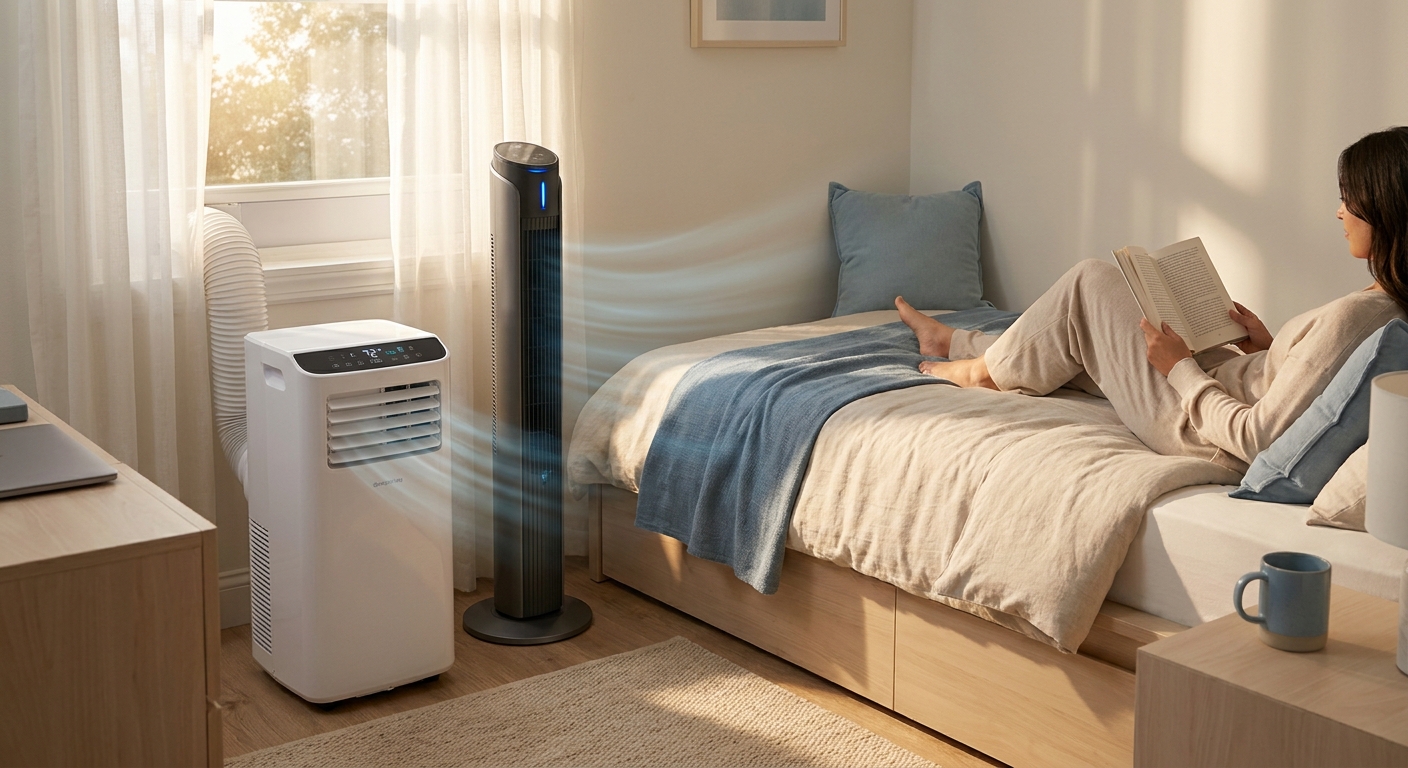
If you are lying in bed at midnight feeling your sheets stick to you while the electric bill keeps climbing, you are not being dramatic. A lot of homes and apartments simply do not cool evenly, and a tired old box fan is no match for humid summer air. The result is familiar. Your bedroom never quite gets comfortable. Your home office turns miserable by midafternoon. Your focus drops, your sleep gets worse, and you keep putting off a fix because sorting through AC specs feels like homework.
Today is one of those rare days when that homework can actually pay off. The best portable ac and smart fan deals today make it possible to cool the rooms you actually use, instead of wasting money trying to blast the whole home. If you choose the right size, check your outlet and window setup, and use app schedules the smart way, you can cut the sweat without getting hammered by your utility bill.
⚡ In a Hurry? Key Takeaways
- The best deal for most people is a right-sized portable AC for the bedroom or office, paired with a smart fan to move cooled air where you actually sit or sleep.
- Before you buy, measure your room, check your window type, and make sure your outlet can handle the unit so you do not end up returning the “cheap” deal.
- Single-hose units are often cheaper, but dual-hose models usually cool faster and waste less energy in hot rooms. Smart fans cost less to run and are great for milder heat.
Why this problem feels worse than it used to
Heat waves are lasting longer, arriving later, and hitting harder in rooms that were never designed to stay cool. That matters if you rent, live in an older home, work upstairs, or have one room that gets cooked by afternoon sun.
A central system, if you even have one, does not always fix that. It may keep the hallway fine while your office still feels like a parked car. And if you do not have central air, every hot day becomes a patchwork solution of open windows, fans, closed blinds, and hope.
That is why these one-day cooling deals matter. This is not about buying another gadget for the sake of it. It is about fixing a quality-of-life problem that keeps showing up every single summer.
Portable AC or smart fan? Start with the room, not the price tag
When a portable AC makes the most sense
Buy a portable AC if you need actual temperature drop, not just moving air around. That usually means bedrooms, nurseries, home offices, gaming rooms, and any space that stays warm even after sunset.
Portable ACs are especially helpful if:
- Your room gets direct afternoon sun
- You sleep hot or humidity keeps waking you up
- You cannot install a window unit
- You need to cool one room without running whole-home AC all day
When a smart fan is enough
A smart fan is the better buy if your room is warm but not truly scorching, or if your AC already works but does a bad job reaching where you are. Fans do not lower room temperature. They help your body feel cooler and can spread conditioned air more efficiently.
That makes them ideal for:
- Bedrooms that are slightly stuffy, not unbearable
- Home offices where you need airflow right at desk level
- Living rooms with decent AC but poor circulation
- People trying to avoid adding a heavy electrical load
How to pick the right portable AC without getting burned by the specs
Room size matters more than “more power”
The biggest mistake people make is buying the cheapest unit on sale or the biggest one they can find. Neither is smart. A too-small unit will run constantly and still leave you sweaty. A too-large one can cycle awkwardly, cool unevenly, and waste money.
As a rough guide:
- Up to 200 square feet: small bedroom, dorm, compact office
- 200 to 350 square feet: average bedroom, larger office
- 350 to 500 square feet: studio area, large bedroom, bonus room
If the room gets intense sun, has high ceilings, or houses heat-making gear like gaming PCs, treadmills, or multiple monitors, size up a bit.
Single-hose vs dual-hose
This is the part many listings bury. Single-hose models are often cheaper and easier to find on sale. They are fine for smaller rooms and lighter use. But dual-hose models usually cool more efficiently in very hot spaces because they handle intake and exhaust better.
If your room gets brutally hot by late afternoon, a dual-hose unit is often worth the extra upfront cost.
Check the real electrical needs
Most smaller portable ACs work on a standard 115V household outlet. That is good news. But you still need to think about what else is on that circuit. If the same outlet area is already running a gaming PC, mini fridge, printer, and charger pile, you may trip breakers.
If possible, give the AC its own outlet. And skip the sketchy extension cord idea. Portable ACs should be plugged directly into a proper wall outlet unless the manufacturer says otherwise.
How to pick a smart fan that actually helps
Focus on airflow and placement
A fan that sits in the wrong corner is just decorative. For sleep, you want airflow across the bed, not at your ankles. For work, you want a steady stream near chest or face level. For a room with AC, place the fan so it pulls cooler air into the space you use most.
App control is more useful than it sounds
Smart fan features can seem gimmicky until you use them. Scheduling a fan to start 30 minutes before bedtime, slow down after you fall asleep, or kick on when a room sensor notices rising temperature is the kind of small convenience that adds up fast.
If heat is already messing with your concentration, this is also a good time to fix the noise side of the problem. If your fan helps but your space is still full of leaf blowers, roommates, or traffic, this guide to Today Only: Noise-Cancelling Headphone Deals That Finally Fix Your ‘Why Is The World So Loud When I’m Just Trying To Focus?’ Problem is worth a look too.
How to make today’s deals save money long after checkout
Stack discounts the boring but effective way
Look for all three layers before you hit buy:
- Sale price
- On-page coupon or promo code
- Utility, credit card, or retailer cashback offer
This is where many people leave money on the table. A portable AC that looks only okay at first glance can become the best value once you stack a coupon with a store promo and local energy rebate.
Use schedules, not brute force
The cheapest cooling setup is the one that runs only when it has to. Set your portable AC to begin cooling the bedroom before bedtime, not after you are already miserable. Use a fan to carry that cool air farther, then let the AC cycle down overnight.
For a home office, pre-cool the room 20 to 30 minutes before work starts. It is much easier to maintain comfort than to rescue a room that already hit sauna mode.
Close the heat out first
Even a great unit fights an uphill battle if sunlight is pouring in. Close blinds or curtains in the hottest part of the day. Seal gaps around the window kit. Keep doors closed if you are trying to cool just one room. These are not glamorous tricks, but they work.
Common buying mistakes to avoid tonight
- Buying based only on BTU number without checking the room size
- Forgetting to confirm the window kit fits your window style
- Putting a portable AC on an overloaded outlet
- Expecting a fan to remove humidity
- Ignoring noise ratings if the unit is for a bedroom
That last one matters. Portable ACs are not silent. If you are a light sleeper, prioritize sleep mode, lower fan settings, and real user reviews over flashy marketing language.
Best setup by room type
Bedroom
Best move: a quiet, properly sized portable AC plus a smart fan on a low overnight schedule. This gives you actual cooling and gentle airflow without freezing the room.
Home office
Best move: a smart fan if the room is mildly warm, portable AC if it turns hot by early afternoon. If you spend all day on calls, noise level matters almost as much as cooling power.
Gaming room or gear-heavy office
Best move: lean toward a stronger or dual-hose portable AC. PCs, consoles, monitors, and lights all dump heat into the room. A fan alone may not cut it.
Apartment living room
Best move: if you are cooling a larger area, use a portable AC near the hottest zone and a fan to spread the air. This usually feels better than setting one fan in the corner and hoping for magic.
At a Glance: Comparison
| Feature/Aspect | Details | Verdict |
|---|---|---|
| Portable AC | Actually lowers room temperature, helps with humidity, best for bedrooms and offices that stay hot. | Best fix if you need real cooling, not just airflow. |
| Smart Fan | Uses much less electricity, improves circulation, can run on schedules or app control. | Best value for mild heat or for boosting existing AC. |
| Deal Strategy | Compare room size, outlet needs, noise level, and stacked coupons or rebates before buying. | The “best” deal is the one that fits your room and does not waste power. |
Conclusion
You do not need to spend another summer pretending the heat indoors is normal. Heat waves are hitting later and lasting longer each year, and a lot of people are trying to sleep, work, or game in rooms that never really cool off. The upside is that the best portable ac and smart fan deals today give you a narrow but very real chance to fix that fast. If you match the gear to your room size, make sure your outlet and window setup can support it, stack the available discounts, and use smart schedules instead of running everything nonstop, you can save money and feel better almost immediately. This is one of those rare purchases that improves your days and your nights. Miss tonight’s prices, and you may be right back to sweating through another season.